What You Don’t Know…
Consider the possibility that none of us can possibly know everything, but we can each know some things really, really well.
Lately, I’ve had more than one client beseech: “Just tell me what to do!” And to be honest, it’s been a bit unsettling, because being on the receiving end of another human being forking over that much trust is a humbling proposition.
But as I’ve been working this over in my mind—much like a six year old who tongues the space where her baby tooth used to be— I realize that the time has come to put our trust in one another.
Strangely, my business is what’s teaching me that I cannot afford to be an island unto myself. As I strive to play “a bigger game”—both in my business and in my life writ large—I am perpetually shown that my vision is so grand, I can’t possibly achieve it as “el lobo solo.”
I need help.
(The shadow axiom? Other people want my help, too).
In a culture that pins our butterfly wings between the two extremes: “do it yourself” or “clean my toilets, fix my car, teach my kids, cook my meals”… it’s little wonder that so many of us are flummoxed and adrift about what to delegate, and what to keep on our to-do lists.
Especially as business owners.
But the ingenuity and thrift that got us to where we are today will not carry us to the fabled “next level” of our enterprise.
It’s often more of a gut-check exercise than we may feel comfortable admitting. Do I trust this person… think this person knows what she’s doing… would I want to sit beside this person at a dinner party/cross-Atlantic flight?
And this principle, that guides you about who to trust, is the very same one that brings other people flowing into your business, too.
Yes, it’s a bit crazy and old-fashioned. And I fully realize it opens us up to some vulnerability, and some risk of being hoodwinked.
But I also have the sense that for our businesses to really flourish, we need to let go of a whole lot of control… and our demands that we know entirely what’s going on around us.
Much like we are asking our favorite clients and customers to do with us.
Which is a particularly curious thing on the inter webs, where so much is so anonymous, unverified, and has the distinct feel of old-timey revivals with the mysterious elixirs and the faith healings and the hallelujahs.
But that’s also one big opportunity for you to stand out among the crowds who also do what you do, but who aren’t as grounded, who don’t provide evidence… and who still rely on the played-out pitch of the snake oil salesmen.
Where will you extend your trust this week, so that others may place their trust in you?
(Photo courtesy of nathanking's flickr photostream.)
Ode to Ikari: What living in Japan taught me…
Just tell me, what do I do to get people to join my programs, buy my product, and become my clients?
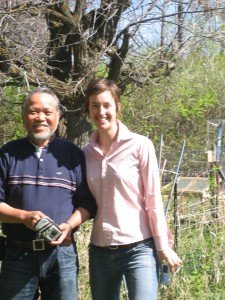
Ikari and me in my Montana backyard, 2007
As we sit and watch and wait and pray after the earthquake and tsunami, my mind drifts to what I personally have learned from Japan.
My first year out of college, I lived in a small Japanese village—Nishihara—on the most southern of the big four islands, about as far from Tokyo as you can get. I was hired on, along with 5,000 other foreign nationals, to teach in a Japanese public school.
In Nishihara, population 5,700, my house was a 5-minute walk across the sports field to the middle school where I taught. On Tuesday afternoons, I rode my bike to one of the village’s 2 elementary schools to teach little kids and play soccer and build bird houses out of bamboo with them. On those days that I pedaled up to the school gates, I was filled with the purest, most humbling kind of joy I’ve ever felt… those little kids running up to me yelling “Sutefanii-sensei… Sutefanii-sensei…” as if I were a rock star.
There’s a distinction that my Japanese friends and neighbors taught me that I’d like to share with you, because it’s so rich, and I don’t think we as Americans are used to thinking in this way.
It’s called honne and tatemae.
Honne is one’s true feeling about something. In Japan, honne isn’t discussed as readily as we seem to do in the States. The way you honestly feel about something is private. It’s your business, not the world’s.
Tatemae, on the other hand, is the face you show the world. It’s the “socially acceptable” or polished version of your private feelings, that you’ve already “digested” behind closed doors… in order to make it ready for public consumption.
More and more in my travels and conversations, I’m seeing business owners who fail to separate the honne from the tatemae in their media, marketing and the way they talk about their work.
And it’s got to stop.
From the classic American viewpoint, the objection here would be: tatemae is fake, honne is being real with people.
And you know what my Japanese friends would say to that?
They’d offer you a cup of green tea with a little cookie, or bring you a bag of sweet potatoes. (Why? Because it’s not Japanese to argue. As my friend Kimiko once said, “In America, conversation is like ping-pong. In Japan, it’s like bowling.” She taught preschoolers in Reno for a couple years before heading back to Nishihara, so she knows a thing or two about us.)
So, what “face” is your website, newsletter, or your other promotional materials showing? And what does your tatemae say to the world about your business… and if it’s the same as your honne, what evidence do you have that this is a good thing? Comments welcome!
This post is dedicated to my friend and Japanese dad Ikari, who has been crazy enough to ride bikes with me on two continents, and call me once a month for the past 13 years to invite me to barbeque at his house in Nishihara again. Happy birthday, oyagi. Thank you for showing me how to be a good friend and ordinary ambassador.
A Tale of 2 Pitches
How do I express what I do so that my favorite kinds of clients are receptive?

How's your business pitching these days?
A woman approached me at the end of a two-hour Chamber luncheon last week, to let me know she now offers credit card processing services. She asked if I have a merchant account, which I do, and how much I pay per month.
When I demurred (who carries that number in their heads?), she continued to sell me. Here’s her point-by-point pitch, along with my inner monologue:
1) You know me (We’d met once before)
2) I can review your current plan for free (Free for her, maybe, but I charge $200/hour and this is not a top priority for me right now-I have QuickBooks to learn and taxes to do. Time spent on this takes away from time spent achieving my goals.)
3) I saved another client $400 a month (RED FLAG: This isn’t me! I spend way less than that A YEAR. She doesn’t know who I am, or what I want.)
4) Can I call you to discuss further? (I’ve already given her at least 2 clear NOs, and she failed to listen to my objections or to answer them in a thoughtful and receptive way).
I’m all for persistence, but I left the conversation feeling like I had to beat her back with a stick. She had her “sales process” down, but she wasn’t using it artfully.
Pitch #2
The next day, I was at my bank opening a business savings account. The banker who helped me looked up from his screen occasionally to offer helpful hints. Like: choose credit even when you use your debit card, because there is a greater chance for fraud when you use your PIN. Hmm... never knew that.
He asked about my business, and how I came up with my business name. He listened to my answers. Then he asked if I had a merchant account. When I said that I had one through another vendor, here was his pitch, point-by-point:
1) I’m so confident that we can save you money on your merchant account that if we can’t, we’ll give you $500 for taking your time to review your current plan. (= risk free guarantee)
2) Your charges go through in one day, instead of 3-4. (HOLY COW, you have my attention… this is a whopper of a selling point. It drives me NUTS that my merchant account takes so long to deliver my hard-earned income to my bank account. Talk about a “pain point” for a small business owner!)
Again I demurred, explaining that I had other priorities for admin and finance right now, but that those 2 points alone were enough to move me when I was ready. “Of course,” he said, and left it at that. We returned to the business at hand, and I walked away wanting a service that I had just turned down the day before.
So, what can you learn from these 2 pitches? You need to be clear about the benefit of your service—and on the ideal client who is hungry for that benefit.
Also, it helps to think of your sales process as more of an exploratory conversation, where you know the outcome you want, but you are present and receptive enough to receive any and all objections… and to “bless & release” the people who actually don’t need (or want) to work with you.
Mighty thanks to Will Folsom's flickr photostream for the image. Oh - and there are still a few spots left in Charm School for Sales Pages, the 4-week course with me to show you how to write a great sales page, and get super-clear on your talking points for your program, service, or product... and your online sales process, with plenty of time to get your questions answered and your sales page up & selling by the end of April. To register: https://stellaorange.com/charmschool.html
Internet Marketing: the Middle Path
When it comes to selling your nectar on the interwebs, must you hand in your humanity and become one of those – *gasp* - Internet Marketers?

Most sales copy is as flat & flavorless as these boxes. It doesn't have to be.
A client just sent me an email that cuts to the core of this issue, subject line: “What bugs me.”
She writes: “Every opt-in ‘funnel’ that I run into lately looks the same… a little plug… what’s your pain… what’s your fear… then request for email addy… repeat …. Repeat again and again and again…”
You know how someone says something out loud you’ve been carrying in your heart that you haven't found words for yet? Writers get that, too.
And my client just nailed what's been bugging me lately.
As a writer and a creative, much of the "sales copy" out there does one of the following:
1) Depresses me
2) Offends me
3) Bores me to tears
In fact, if I see the words OVERWHELMED, "take your business to the next level", STRUGGLING, or YOU'RE NOT ALONE again, I just might scream. (Let's keep "stop leaving money on the table" on this list, too. Ugh! Is anyone else breaking out into shingles right now?)
It leaves me with the distinct sense that we're these insecure, sniveling Vienna Sausages who have just been waiting for someone to tell us what to do... instead of business owners who want: 1. to know what works 2. how to put that into action without losing our shirts, sanity or self-respect and 3. more time to do things we love that don't pay us as well as our businesses do (like sitting in the sunshine, travel, making art, growing young humans, or napping).
So when YOU want to build out the online part of your business and marketing, you don’t want to be a cheeseball, a sleazeball, or do what everyone else is doing, right? Plus, is what you see everyone doing online REALLY working?
(Anyone else out there have the strong suspicion there’s a wizard who invents “internet marketing strategy” and distributes it through all our viral and virtual channels... and she’s just getting the biggest kick out her memes fanning out through the entrepreneur population?)
After all, internet marketing is like a virtual magic show. There’s a lot of smoke and mirrors. And when the guy in the top hat saws the lady in a box into two pieces and she makes $6,734 in less than 2 weeks working only 3 hours a day, you know in your gut it’s an illusion, but you still don’t know how the trick is done.
But what really makes me want to kiss my client is her question: “Is there another way?”
Yes, yes, there is. And, dear reader, we are the ones to create it.
It starts with you. How you talk about – and write about—your business. Whether your emails start from a place of “I need to sell 40 of these to pay my mortgage” or what my actor friend Kent calls “Hey – wanna see something cool?” Whether or not you let your clients know you don’t check email on the weekends because you’re human, not a production line.
And it starts with paying attention to what turns you off on the web-- and in your inbox-- and what turns you on. Lights you up. Makes your day better. Feels like a breeze through your mind. Simplifies your workday.
So, dear reader, here’s to the middle path of internet marketing. Not so airy-fairy as to leave your readers, customers, and clients scratching their heads saying “not sure what all that transformation talk and mandalas were about, but at least she’s expressing herself.” Not so hard-core as to leave them feeling like you’d sell your own mother’s kidney through your merchant account. The middle path: charmingly intelligent and delightfully real.
The first step is to notice who’s getting it right – and I’d love to hear who you like and follow in the comments below.
There are still spots left in Charm School for Sales Pages, the 4-week class on writing powerful, charming copy that moves people to opt-in, register for your program or call, or buy one of your products direct from your website. Starts March 22. To get more info or to sign up, click here. Oh, and thanks to SqueakyMarmot's flickr photostream for the photo, and Jolin for the inspired topic. Seriously. This is an itch I've been dying to scratch. Thank you for the idea!
