Ode to Ikari: What living in Japan taught me…
Just tell me, what do I do to get people to join my programs, buy my product, and become my clients?
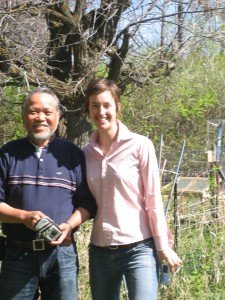
Ikari and me in my Montana backyard, 2007
As we sit and watch and wait and pray after the earthquake and tsunami, my mind drifts to what I personally have learned from Japan.
My first year out of college, I lived in a small Japanese village—Nishihara—on the most southern of the big four islands, about as far from Tokyo as you can get. I was hired on, along with 5,000 other foreign nationals, to teach in a Japanese public school.
In Nishihara, population 5,700, my house was a 5-minute walk across the sports field to the middle school where I taught. On Tuesday afternoons, I rode my bike to one of the village’s 2 elementary schools to teach little kids and play soccer and build bird houses out of bamboo with them. On those days that I pedaled up to the school gates, I was filled with the purest, most humbling kind of joy I’ve ever felt… those little kids running up to me yelling “Sutefanii-sensei… Sutefanii-sensei…” as if I were a rock star.
There’s a distinction that my Japanese friends and neighbors taught me that I’d like to share with you, because it’s so rich, and I don’t think we as Americans are used to thinking in this way.
It’s called honne and tatemae.
Honne is one’s true feeling about something. In Japan, honne isn’t discussed as readily as we seem to do in the States. The way you honestly feel about something is private. It’s your business, not the world’s.
Tatemae, on the other hand, is the face you show the world. It’s the “socially acceptable” or polished version of your private feelings, that you’ve already “digested” behind closed doors… in order to make it ready for public consumption.
More and more in my travels and conversations, I’m seeing business owners who fail to separate the honne from the tatemae in their media, marketing and the way they talk about their work.
And it’s got to stop.
From the classic American viewpoint, the objection here would be: tatemae is fake, honne is being real with people.
And you know what my Japanese friends would say to that?
They’d offer you a cup of green tea with a little cookie, or bring you a bag of sweet potatoes. (Why? Because it’s not Japanese to argue. As my friend Kimiko once said, “In America, conversation is like ping-pong. In Japan, it’s like bowling.” She taught preschoolers in Reno for a couple years before heading back to Nishihara, so she knows a thing or two about us.)
So, what “face” is your website, newsletter, or your other promotional materials showing? And what does your tatemae say to the world about your business… and if it’s the same as your honne, what evidence do you have that this is a good thing? Comments welcome!
This post is dedicated to my friend and Japanese dad Ikari, who has been crazy enough to ride bikes with me on two continents, and call me once a month for the past 13 years to invite me to barbeque at his house in Nishihara again. Happy birthday, oyagi. Thank you for showing me how to be a good friend and ordinary ambassador.

March 21st, 2011 - 21:54
Could you give an example of what you’re talking about? I’m unclear. Are you saying that it’s ok for us to have a private side, and we don’t have to share all that personal stuff with the world around us? I’m thinking that’s what you mean. Your other posts are crystal clear, but this one has me confused and I’ve read it 3 times. Sorry! I really want to understand your message because I have a feeling it’s really powerful and I may be missing something obvious and helpful. Thanks.
March 23rd, 2011 - 08:09
Stephanie, enjoyed your post. As I get ready to review some of my marketing , I realized that I am 80 % Honne and 20% Tatemae. The problem is that I am not used to sharing my Honne…therefore I am not doing a good job communicating anything…
I will keep this distinctions fresh , as I go thru my Q2 clean house marketing!
Pilar
March 24th, 2011 - 06:50
Sure, Carol - and thanks for the feedback (I’m playing with not being totally direct, to just give ideas that might spark a move in a new direction. Clearly, we are all learning as we go!)
An example: Your powerful story. Self-disclosing is a powerful technique to connect with others. (Just watch how powerful public speakers and those “big coaches” tell not only how they achieved, but where they really had a hard go of it). But this is a story that’s been “curated” — certain facts have been picked because they make a certain point, and reinforce your message. (I share that I’ve been a high school teacher and fundraiser for a community-based art center. I don’t mention that I made coffee in grad school, or that I clerked for a venture capital law firm.)
My point is: know your honne - what’s really going on for you, where you’ve been - but process and “digest” it before you stick it in your marketing and the “tatemae” message you share with the world. Marketing and networking and sales conversations are really more performance and theater-based than you’d think, and I want folks to be aware that even “authentic marketers” or “heart-based business owners” are telling-and usually, selling-you a story.
Anyone have another example?
March 24th, 2011 - 06:54
Pilar, I know what you mean. As my friends would tell you, I actually tend to be a private person with personal details. I’d rather hear what someone else sees or knows. But I’m learning that sharing our “honne”… once we’ve processed it… builds trust, and helps us connect with one another. Good luck with your Q2 housekeeping!